
Who decides, and on what evidence.
The proposed governance structure separates verification from commercial interests. Decisions must be supported by evidence, recorded with reasons and open to appeal. Committee appointments, delegated powers and the independent audit arrangement still need confirmation.
No decision rests on one source
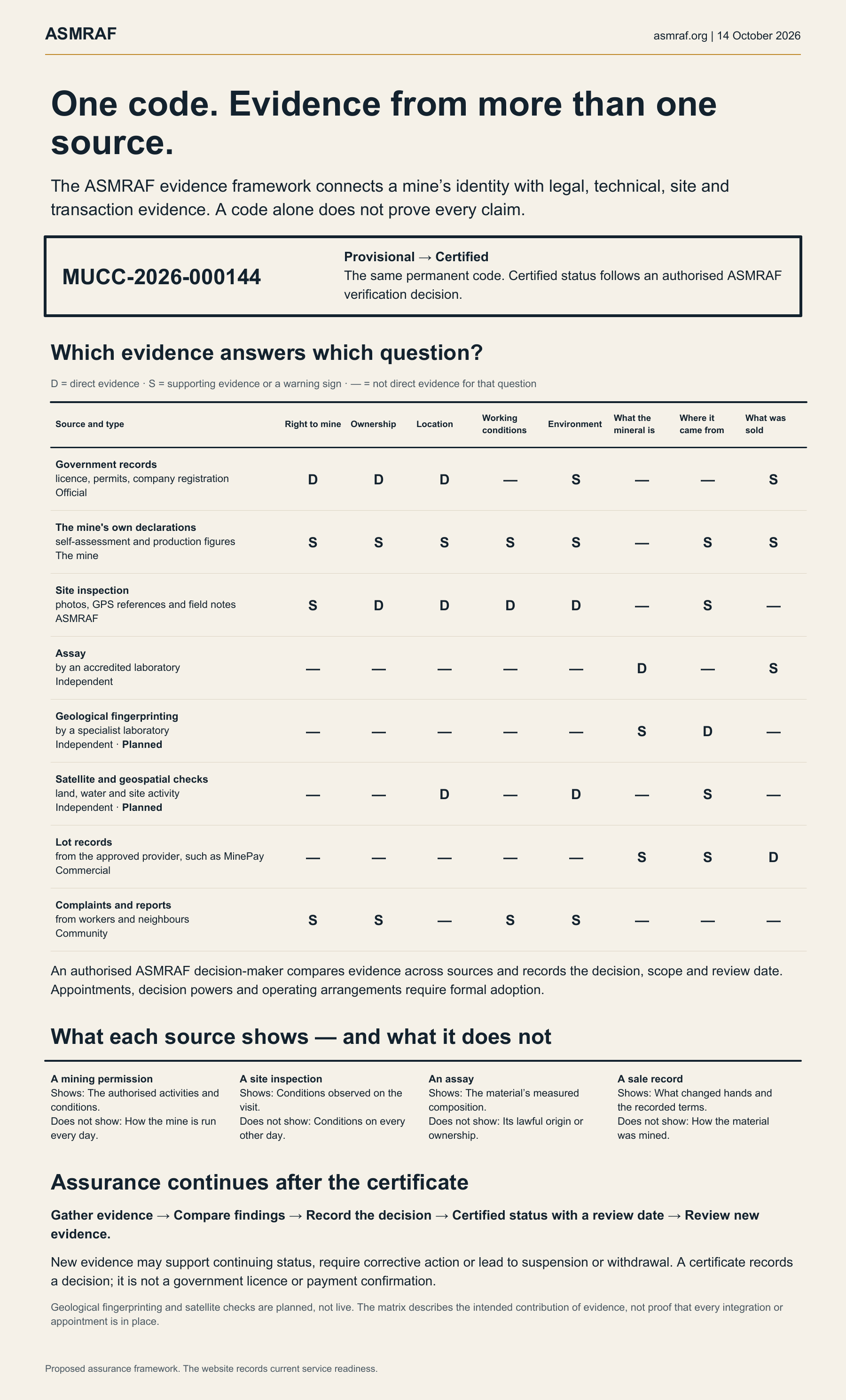
A mining licence proves the right to mine, not how the mine is run. A site inspection shows one day. An assay shows what a mineral is, not where it came from. A sale record shows what changed hands, not how it was mined. Each source proves one thing, so ASMRAF compares them, and decides only when they agree.
Every piece of evidence is filed under the mine’s one MUCC code, such as MUCC-2026-000144, so sources can be compared side by side.
| Source | Kind | Right to mine | Ownership | Location | Working conditions | Environment | What the mineral is | Where it came from | What was sold |
|---|---|---|---|---|---|---|---|---|---|
| Government records: licence, permits, company registration | Official | direct evidence | direct evidence | direct evidence | supporting evidence or a warning sign | supporting evidence or a warning sign | |||
| The mine’s own declarations: self-assessment and production figures | The mine | supporting evidence or a warning sign | supporting evidence or a warning sign | supporting evidence or a warning sign | supporting evidence or a warning sign | supporting evidence or a warning sign | supporting evidence or a warning sign | supporting evidence or a warning sign | |
| Site inspection: photos, GPS references and field notes | ASMRAF | supporting evidence or a warning sign | direct evidence | direct evidence | direct evidence | direct evidence | supporting evidence or a warning sign | ||
| Assay: by an accredited laboratory | Independent | direct evidence | supporting evidence or a warning sign | ||||||
| Geological fingerprinting: by a specialist laboratory Planned | Independent | supporting evidence or a warning sign | direct evidence | ||||||
| Satellite and geospatial checks: land, water and site activity Planned | Independent | direct evidence | direct evidence | supporting evidence or a warning sign | |||||
| Lot records: from the approved provider, such as MinePay | Commercial | supporting evidence or a warning sign | supporting evidence or a warning sign | direct evidence | |||||
| Complaints and reports: from workers and neighbours | Community | supporting evidence or a warning sign | supporting evidence or a warning sign | supporting evidence or a warning sign | supporting evidence or a warning sign |
Right to mine
- direct evidenceGovernment records Official
- supporting evidence or a warning signThe mine’s own declarations The mine
- supporting evidence or a warning signSite inspection ASMRAF
- supporting evidence or a warning signComplaints and reports Community
Ownership
- direct evidenceGovernment records Official
- direct evidenceSite inspection ASMRAF
- supporting evidence or a warning signThe mine’s own declarations The mine
- supporting evidence or a warning signComplaints and reports Community
Location
- direct evidenceGovernment records Official
- direct evidenceSite inspection ASMRAF
- direct evidenceSatellite and geospatial checks Planned Independent
- supporting evidence or a warning signThe mine’s own declarations The mine
Working conditions
- direct evidenceSite inspection ASMRAF
- supporting evidence or a warning signThe mine’s own declarations The mine
- supporting evidence or a warning signComplaints and reports Community
Environment
- direct evidenceSite inspection ASMRAF
- direct evidenceSatellite and geospatial checks Planned Independent
- supporting evidence or a warning signGovernment records Official
- supporting evidence or a warning signThe mine’s own declarations The mine
- supporting evidence or a warning signComplaints and reports Community
What the mineral is
- direct evidenceAssay Independent
- supporting evidence or a warning signGeological fingerprinting Planned Independent
- supporting evidence or a warning signLot records Commercial
Where it came from
- direct evidenceGeological fingerprinting Planned Independent
- supporting evidence or a warning signThe mine’s own declarations The mine
- supporting evidence or a warning signSite inspection ASMRAF
- supporting evidence or a warning signSatellite and geospatial checks Planned Independent
- supporting evidence or a warning signLot records Commercial
What was sold
- direct evidenceLot records Commercial
- supporting evidence or a warning signGovernment records Official
- supporting evidence or a warning signThe mine’s own declarations The mine
- supporting evidence or a warning signAssay Independent
direct evidencesupporting evidence or a warning sign
This is an evidence framework, not a list of live integrations. Reviewers must assess reliability and gaps, investigate contradictions and record a reasoned decision; matching sources alone do not prove compliance.
Download the evidence framework as an image (PNG) or a PDF.
Assurance doesn’t stop at the certificate
Evidence gathered from the sources above.
Evidence compared, question by question.
The Certification Committee decides.
Certified status with a recorded review date, while visits, assays, lot records and complaints keep coming in.
New evidence reviewed: the code is renewed, a fix is agreed, or the code is suspended.
Then the cycle starts again. A certificate doesn’t create trust: it records what the evidence showed on the day of the decision, and stays valid only while new evidence keeps agreeing.
Proposed responsibilities
The Secretariat runs the programme day to day. It keeps the register of verified mines, coordinates partners, issues codes and certificates, and commissions independent audits.
The Certification Committee, with members from mining co-ops, industry, civil society and regulators, reviews each mine’s evidence and audit findings, and decides verification, renewal and suspension. Members with a stake in a mine or its minerals step out of that mine’s decision. Final decision powers and membership require formal adoption.
The Technical and Digital Oversight Unit keeps the traceability systems secure: who can see what, privacy, fraud checks, and training for miners and partners. It works with approved providers such as MinePay, but doesn’t answer to them.
The Regulatory Coordination Forum brings government ministries, geological surveys and local authorities together on licensing, tax and export controls.
Independent external auditors check the whole system, verify data and spot-check verified mines, and report what needs to change to the Secretariat and the Certification Committee. The independent auditor and appointment date are not yet confirmed.
Complaints, appeals and improvement
- Anyone can raise a concern or request an appeal. The draft procedure requires a logged case, a reasoned response and an appeal reviewer who was not involved in the original decision. No round-the-clock response service is promised.
- Consultations, system reviews and training feed what we learn back into the standard and our policies.
Independence
ASMRAF is a not-for-profit. Verification is kept apart from buying, selling and payment: approved providers such as MinePay run sales under a non-exclusive agreement and take no part in verification decisions. Committee members declare their interests, and anyone with a conflict steps out of that decision.